

National MSc in Artificial Intelligence
Part-fundedRedefine possibilities with technology
AI is fundamentally altering the way in which society functions. Get the right training to help guide your business in the right direction.
This 2-year online part-time MSc in Artificial Intelligence, delivered in partnership with University of Limerick, is an exciting programme that will provide you with robust knowledge and skills in the application of Artificial Intelligence (AI) and Machine Learning.
AI is at the heart of many transformational business and technical applications. AI applications using massive datasets, powerful computing architectures and advanced learning algorithms are contributing to business growth and societal benefit in fields such as health, education, finance, telecoms, leisure and transport, while AI-enhanced services are fundamentally altering the way in which society functions, with this trend is set to continue and accelerate.
This unique programme will equip you with a knowledge-base and an advanced skillset to become highly capable experts for this strategically important sector. Current and potential AI engineers will receive the skills, theory and recognition they need to develop in their role, through a mixed learning process with a large emphasis on practical application in the workplace.
The programme is industry-led and has been developed with industry-support to ensure content is highly relevant, while being delivered in a manner that will suit professionals. Companies that have supported the content development of this course include: Accenture, Advanced Metadata, Analog Devices, Citibank, Dell EMC, Emdalo Technologies, Ericsson, IBM, iMage Vision, Jaguar Land Rover, Movidius an Intel Company, Microsoft, Nokia Bell Labs, Soapbox Labs, and Valeo Vision Systems.
The National MSc in Artificial Intelligence runs over 2 years part-time and is delivered fully online, including all exams and assessments, using state-of-the-art online delivery models in which the student experience plays a central role.
There are 5x teaching semesters and 1x research project semester. Modules will be delivered with associated assessment of mastery so that semester-by-semester there is a measurable achievement of learning objectives that can be transferred directly and immediately to the workplace. Assessments are largely continuous and based on assignments and project work with a practical rather than theoretical focus.
Contact time will vary from 2 to 4.5 hours per week over the semester, but students will be expected to make about a 15-20 hour commitment per week on average to include lecture time, study, research, assignment time etc.
One distinguishing quality of the National MSc in Artificial Intelligence is that each and every module delivered was designed solely for this programme. The online nature of delivery allows you to explore relevant subjects in a self-driven manner, with expert support from module leaders and moderators who guide students in smaller groups.
Certificate in Artificial Intelligence
In advance of the full masters programme, students must complete the preparatory Certificate in Artificial Intelligence in the preceding Autumn semester. Successful completion of the preparatory Course will lead to the award of a Certificate in Artificial Intelligence by UL (Special Purpose Award, Level 8, 12 ECT credits).
The objective is to introduce the associated scientific computing, programming language and host platforms. The first module will focus on relevant scientific computing using Python and its core packages. The second module will introduce Deep Learning and the associated frameworks e.g. TensorFlow.
There will be typically one hour of lectures and tutorials in total per week from Weeks 1-14 with further engagement through forum interactions.
Year 1
In year 1, students will lay the practical and theoretical foundations for a firm understanding of AI and machine learning algorithms and workflows. Moreover, students will learn to appreciate the important ethical considerations associated with AI and machine learning and will select and start investigating a research topic.
Year 1 modules include
- Introduction to Scientific Computing for AI
- Introduction to Deep Learning and Frameworks
- Artificial Intelligence and Machine Learning
- Data Analytics
- Advanced Topics Seminars and Project Specification
- Risk, Ethics, Governance and Artificial Intelligence
Year 2
In Year 2, students can choose to follow the Modern Machine Learning stream, Natural Language Processing stream or Computer Vision stream.
- The Modern Machine Learning stream modules include:
- Machine Learning Applications
- Machine Vision
- Deep Learning
- Artificial Intelligence and Data Science Ecosystems: Theory and Practice
- The Natural Language Processing stream modules include:
- Natural Language Processing: An Introduction
- Information Retrieval
- Advanced Natural Language Processing
- Natural Language Understanding
- The Computer Vision stream modules include:
- Deep Learning for Computer Vision
- Machine Vision and Image Processing
- Geometric Computer Vision
- Natural Language Understanding & Applications
A major dissertation project will be selected and specified within the first year and completed throughout the second year.
Click here to learn more: Dr. Pepijn van de Ven, Senior Lecturer at University of Limerick and Course Director for our industry-driven programme, discusses critical aspects of the programme as part of his appearance on the AI Ireland podcast.
Assessment
Modules use mostly continuous assessment with a few modules using a relatively small end-of-semester exam. Assessments form a large part (around 50% or more) of most modules.
Academic Eligibility
The principal entry requirement for both the Masters course and the Preparatory Course is a Level 8 honours degree, at minimum second class honours (NFQ or other internationally recognised equivalent), in a relevant engineering, computing, mathematics, science or technology discipline.
Python will be used throughout and experience in this language is advantageous, but not a prerequisite. The first module on the programme allows students to obtain sufficient coding skills for the programme.
Applicants from other disciplines who have a significant mathematics or computing (i.e. programming) element in their primary degree will also be considered.
Applicants who possess an honours undergraduate degree, at minimum second-class honours, or equivalent in a non-numerate discipline and have a minimum of three years experiential learning in an appropriate computing discipline (with a high level of either mathematics or programming) may also apply. Their admission to the program will be determined by the University of Limerick.
Applicants who do not meet the requirements above may be considered under the University of Limerick policy that allows for the recognition of Prior Learning, both formal and informal/experiential learning; non-accredited personal and professional education; and work based training. As this is a highly technical Masters course, such applicants must have sufficient competence in mathematics and computer programming to be able to participate.
Fees
Fees for 2027 are to be confirmed.
For reference, the 2026 fees were are follows:
Full course fee: €5,940 per year
Technology Ireland ICT Skillnet grant: €2,045 per year
Subsidised course fee: €3,895* per year
There is an additional subsidised fee of €1,950 in Year 1 for the mandatory Certificate in Artificial Intelligence
Subsidised fees are only available to eligible* applicants.
*Funding Eligibility
Applicants must be employed by, or operating as, an eligible business engaged in economic activity in the Republic of Ireland. This includes private companies, sole traders, commercial social enterprises and eligible commercial semi-state organisations. Additional eligibility verification may be required for certain organisation types to avail of grant-aided fees.
Applicants who do not meet our funding criteria may be able to apply directly to the college and pay the full course fee if there are available places.
Once you have received your offer of a place on the course, please be aware that we have a limited number of subsidised places available. Due to high demand, we cannot hold places without payment. To ensure fairness, priority for these places will be granted to those who have both completed full payment of the subsidised fee and are deemed eligible by the college or training provider.
Applications are now closed for 2026.
Please complete the Make an Enquiry form on this page and we will contact you when applications open in 2027.
The University of Limerick has sole discretion and is the final arbiter on who will participate. Making an application is not a guarantee of selection. Applications are treated in strictest confidence.
Applicants accept that no feedback will be provided to them, or any other party, regarding the selection process nor will applicants be provided with any reason for their non-selection.
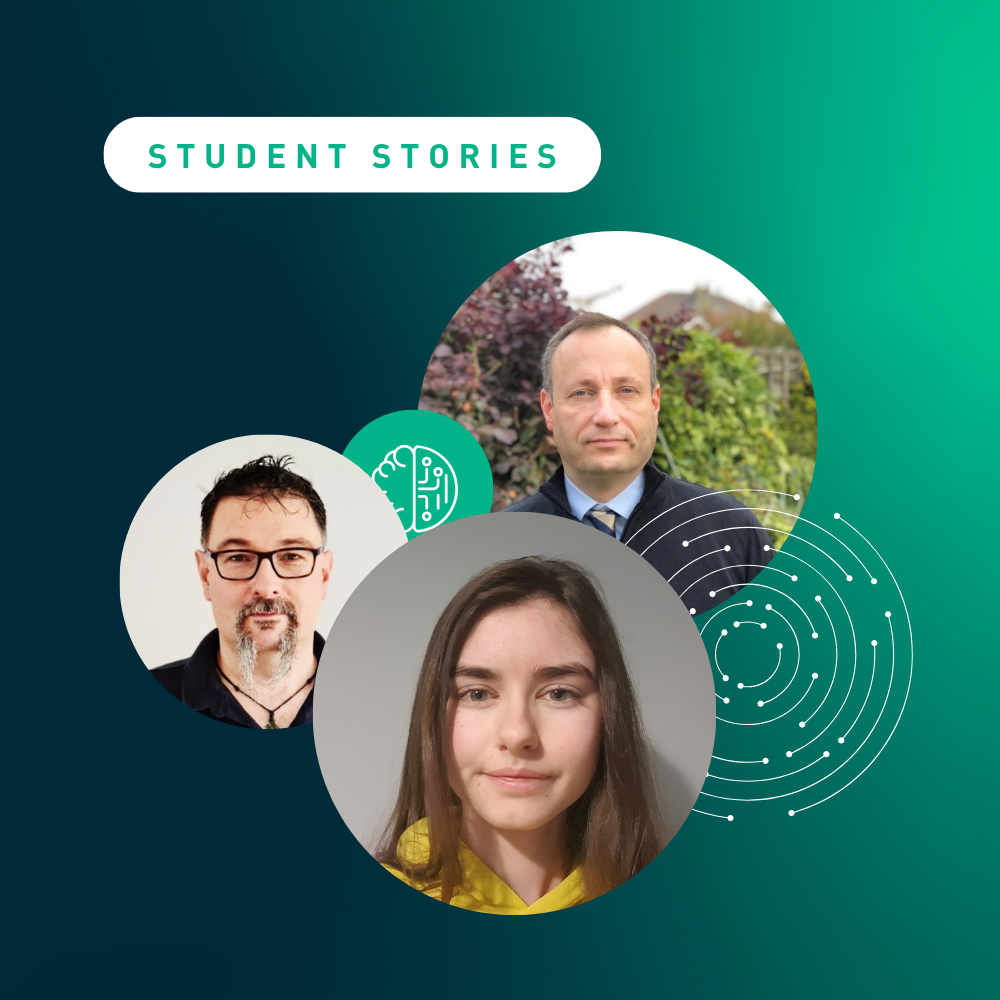
Hear from professionals who have completed the National MSc in AI
Three recent graduates share what it takes to complete the programme alongside a full-time career, how they approached the workload, and how they are applying their AI knowledge in the workplace.
Featuring perspectives from graduates working at Dell Technologies, onsemi and Neuralstorm.
Read their experiencesWhat former students say about the course
Frequently Asked Questions
The questions our team are asked most often about this programme. If your question is not answered here, make an enquiry and we will come back to you.
As this is a highly technical Master’s course, applicants must have sufficient competence in mathematics and computer programming to be able to participate. The principal entry requirement is a Level 8 honours degree in a relevant engineering, computing, mathematics, science or technology discipline. Applicants who do not meet the requirements above may be considered under the University of Limerick’s Recognition of Prior and Experiential Learning which takes into account the applicant’s knowledge, skills, and experience. We will guide you through the process.
The course uses an appropriate mix of theory and applications. Students will be able to apply machine learning theory to real-world problems in all modules. Python will be used throughout and experience in this language is advantageous, but not a prerequisite. The first module on the programme allows students to obtain sufficient coding skills for the programme.
Assessment is largely based on assignments and online exams with a practical rather than theoretical focus.
The fees are subsidised by Technology Ireland ICT Skillnet for eligible participants, which reduces the yearly cost of the National MSc in Artificial Intelligence. There is an additional subsidised cost for the 14-week compulsory preparatory certificate course. All fees in each year are payable prior to the commencement date in that year.
Applicants must be employed by, or operating as, an eligible business engaged in economic activity in the Republic of Ireland. This includes private companies, sole traders, commercial social enterprises and eligible commercial semi-state organisations. Additional eligibility verification may be required for certain organisation types to avail of grant-aided fees.
Candidates should first apply to Technology Ireland ICT Skillnet for initial eligibility screening. Once your eligibility is confirmed, we will send you the link to the University of Limerick application portal. You will need your Academic transcripts and certificates for the formal application. Once you receive an Offer from University of Limerick, Technology Ireland ICT Skillnet will guide you through making your payment and accepting your grant-aided offer.
You may be able to apply directly to University of Limerick for the National MSc in Artificial Intelligence, paying the full course fees while places are still available.
Candidates should bear in mind that this is a level 9 programme. Contact time will vary from 2 to 4.5 hours per week over the semester, but students will be expected to make approximately a 15-20 hour commitment per week on average to include lecture time, study, research, assignment time etc.
The National MSc in Artificial Intelligence programme runs over 2 years with 5 teaching semesters and 1 research project semester, including the Certificate in Artificial Intelligence in semester 1. Participants must complete the preparatory Certificate in Artificial Intelligence to the equivalent of a 2nd class honours level to be eligible for entry to the Masters, regardless of their prior qualifications or experience.
The objective of the 14-week Certificate in AI is to introduce scientific computing, programming languages, and host platforms. The two modules are:
- Introduction to Scientific Computing for AI Introduces the core mathematics and core programming skills required in machine learning. You will hone your Python coding skills as well as your knowledge and skills in Calculus, Linear Algebra and Probability Theory as the three core areas of mathematics that underpin machine learning.
- Introduction to Deep Learning and Frameworks Previews the exciting possibilities that modern machine learning offers, introducing you to the core methods used in machine learning and state-of-the-art networks, such as Convolutional Neural Networks.
Yes, you can view the modules by clicking here. You can access module descriptors via the UL website by clicking here. Enter the module title (or module code) into the search bar.
The National MSc in Artificial Intelligence programme has been developed with the full-time working student in mind with a mixture of asynchronous lectures (access at any time), synchronous lectures (on-line at specific times) and moderated online discussions.
The live sessions are generally held in the evenings outside of regular work hours. Days and time for these are confirmed prior to module start. It is usually one per week per module. These sessions are recorded and made available for students who cannot attend the live sessions.